
BBS 1st Year Principle of Management Notes in English and Nepali 2082
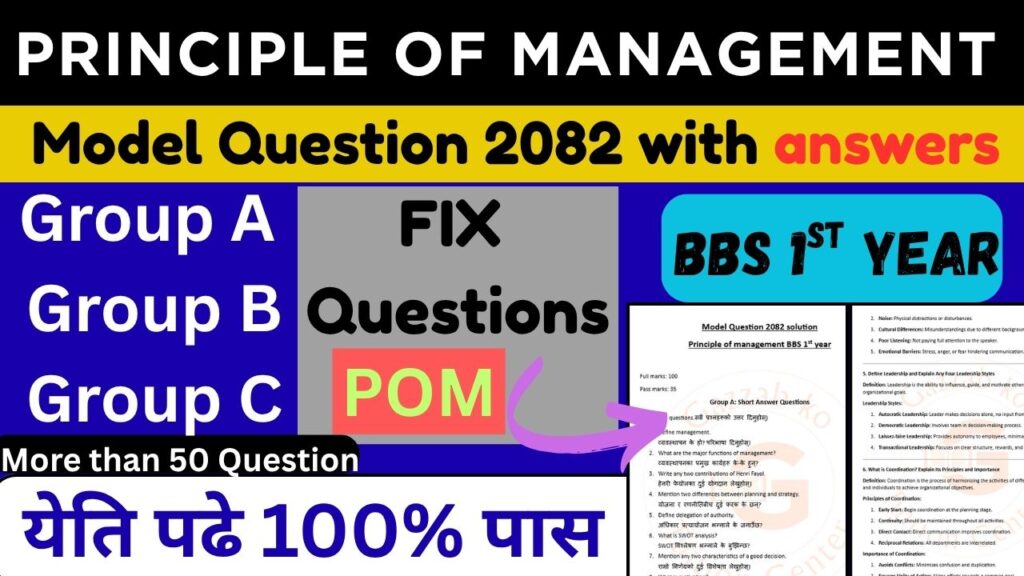
You can download notes from here..
Notes in English and Nepali bbs 1st year POM
You can easily download the notes PDF from here, BBS 1st Year POM model set question with solution 2082
For more information : 9802831152
Chapter 11: Managing in the Global Arena
2 Marks Questions (Very Short Answer)
- What is globalization?
- ग्लोबलाइजेसन भन्नाले के जनाउँछ?
- Define multinational company (MNC).
- बहुराष्ट्रिय कम्पनी (MNC) भन्नाले के जनाउँछ?
- What is international business?
- अन्तर्राष्ट्रिय व्यापार भनेको के हो?
- Mention any two advantages of globalization.
- ग्लोबलाइजेसनका दुई फाइदाहरू उल्लेख गर्नुहोस्।
- What is ethnocentric attitude?
- Ethnocentric attitude भनेको के हो?
10 Marks Questions (Short Answer)
- Describe the main advantages and disadvantages of globalization.
- ग्लोबलाइजेसनका प्रमुख फाइदा र बेफाइदाहरू वर्णन गर्नुहोस्।
- What are the challenges of managing in a global environment?
- ग्लोबल वातावरणमा व्यवस्थापन गर्दा आउने चुनौतीहरू के–के हुन्?
- Explain the roles and importance of multinational companies.
- बहुराष्ट्रिय कम्पनीहरूको भूमिका र महत्व स्पष्ट गर्नुहोस्।
- Differentiate between ethnocentric, polycentric, and geocentric attitudes.
- Ethnocentric, polycentric र geocentric दृष्टिकोणबीच फरक के छ?
15 Marks Questions (Long/Analytical Answer)
- Define globalization and explain its impact on management practices.
- ग्लोबलाइजेसन भन्नु के हो? व्यवस्थापन अभ्यासमा यसको प्रभाव स्पष्ट गर्नुहोस्।
- Analyze the benefits and challenges of globalization from a developing country’s perspective.
- विकासोन्मुख देशको दृष्टिकोणले ग्लोबलाइजेसनका फाइदा र चुनौतीहरूको विश्लेषण गर्नुहोस्।
Chapter 12: Management Trends and Scenario in Nepal
2 Marks Questions (Very Short Answer)
- What is privatization?
- निजीकरण भनेको के हो?
- Mention any two trends of management in Nepal.
- नेपालमा व्यवस्थापनका दुई प्रवृत्तिहरू उल्लेख गर्नुहोस्।
- What is liberalization?
- उदारीकरण भन्नाले के जनाउँछ?
- Define NGOs and INGOs.
- NGO र INGO भन्नाले के जनाउँछ?
- Mention two problems of management in Nepal.
- नेपालमा व्यवस्थापनका दुई समस्याहरू लेख्नुहोस्।
10 Marks Questions (Short Answer)
- What are the major problems of management in Nepal? Explain.
- नेपालमा व्यवस्थापनका प्रमुख समस्याहरू के–के छन्? स्पष्ट गर्नुहोस्।
- Describe the emerging trends of management in Nepal.
- नेपालमा देखा परेका व्यवस्थापनका नयाँ प्रवृत्तिहरू वर्णन गर्नुहोस्।
- Explain the role of NGOs and INGOs in the development of Nepal.
- नेपाल विकासमा NGO र INGO हरूको भूमिका स्पष्ट गर्नुहोस्।
- What is privatization? What are its advantages and disadvantages in Nepal?
- निजीकरण भन्नाले के बुझिन्छ? नेपालमा यसको फाइदा र बेफाइदा के हुन्?
15 Marks Questions (Long/Analytical Answer)
- Discuss the current scenario of management in Nepal. What improvements are necessary?
- नेपालमा वर्तमान व्यवस्थापनको अवस्थाबारे छलफल गर्नुहोस्। सुधारका लागि के आवश्यक छन्?
- Analyze the major management trends in Nepal and the challenges faced by managers.
- नेपालमा प्रमुख व्यवस्थापन प्रवृत्तिहरू र व्यवस्थापकहरूले भोग्नुपरेका चुनौतीहरूको विश्लेषण गर्नुहोस्।
BBS 1st Year – Principles of Management
Model Question for 2082 SET 2
Full Marks: 100
Time: 3 Hours
Group A: Short Answer Questions
(Attempt All Questions – 10 × 2 = 20 Marks)
- Define organization. (Chapter 1)
संगठन भनेको के हो? - What are the main functions of management? (Chapter 2)
व्यवस्थापनका मुख्य कार्यहरू के हुन्? - Write any two principles of scientific management. (Chapter 3)
वैज्ञानिक व्यवस्थापनका दुई सिद्धान्तहरू लेख्नुहोस्। - Define general environment. (Chapter 4)
सामान्य वातावरण भनेको के हो? - What is decision-making? (Chapter 5)
निर्णय प्रक्रिया भन्नाले के बुझिन्छ? - Mention any two principles of organizing. (Chapter 6)
संगठनको दुई सिद्धान्तहरू उल्लेख गर्नुहोस्। - Define motivation. (Chapter 7)
प्रेरणा भन्नाले के बुझिन्छ? - What is communication? (Chapter 8)
संचार भन्नाले के हो? - Mention two steps of control process. (Chapter 9)
नियन्त्रण प्रक्रियाका दुई चरणहरू लेख्नुहोस्। - What is globalization? (Chapter 10)
विश्वव्यापीकरण भन्नाले के हो?
Group B: Descriptive Questions
Attempt any five Questions – 5 × 10 = 50 Marks
- Explain the major characteristics and importance of organizations. (Chapter 1)
संगठनका प्रमुख विशेषताहरू र महत्त्वको व्याख्या गर्नुहोस्। - Describe the functions and roles of a manager. (Chapter 2)
प्रबन्धकका कार्यहरू र भूमिकाहरू वर्णन गर्नुहोस्। - Define business environment. Explain the internal and external environment of business. (Chapter 4)
व्यवसायिक वातावरण भन्नाले के बुझिन्छ? आन्तरिक र बाह्य वातावरणको वर्णन गर्नुहोस्। - What is planning? Describe the steps involved in planning. (Chapter 5)
योजना के हो? योजना प्रक्रियाका चरणहरू वर्णन गर्नुहोस्। - Define leadership. Explain any four leadership styles with examples. (Chapter 7)
नेतृत्व के हो? कुनै चार नेतृत्व शैलीहरू उदाहरणसहित वर्णन गर्नुहोस्। - Define controlling. Explain the steps in the control process. (Chapter 9)
नियन्त्रण के हो? नियन्त्रण प्रक्रियाका चरणहरूको वर्णन गर्नुहोस्।
Group C: Analytical/Case Questions
(Attempt Any Two – 2 × 15 = 30 Marks)
- Explain the importance of leadership and motivation in achieving organizational goals. (Chapter 7)
संगठनका लक्ष्यहरू प्राप्त गर्न नेतृत्व र प्रेरणाको महत्त्व स्पष्ट गर्नुहोस्। - Case Study: A company is failing to adapt to changes in the external environment. As a manager, what steps would you take to make your organization more flexible and responsive? (Chapter 4)
केस स्टडी: एउटा कम्पनी बाह्य वातावरणमा भएका परिवर्तनहरूलाई आत्मसात गर्न असफल भइरहेको छ। प्रबन्धकको रूपमा तपाईं कुन कदम चाल्नुहुन्छ? - You are appointed as a global manager. What challenges and management practices would you implement to operate effectively in a foreign country? (Chapter 10)
तपाईंलाई एक अन्तर्राष्ट्रिय प्रबन्धकको रूपमा नियुक्त गरिएको छ। विदेशी देशमा प्रभावकारी सञ्चालनका लागि तपाईंले कुन चुनौती र व्यवस्थापन अभ्यासहरू प्रयोग गर्नुहुन्छ?
Copyright Disclaimer for Website (Use for Footer or Notes Page)
© 2025 Gazzab Ko Tuition Center. All rights reserved.
All content on this website, including but not limited to BBS 1st Year Principles of Management notes, model questions, answers, exam tips, and study materials for the 2082 session, is the intellectual property of Gazzab Ko Tuition Center.
No part of this content may be copied, reproduced, republished, uploaded, posted, transmitted, or distributed in any form or by any means without prior written permission from the website owner.
🚫 Unauthorized copying, distribution, or reuse of our content is strictly prohibited and may result in legal action under the Copyright Act of Nepal and international copyright laws.
If you wish to use our content for educational purposes, you must:
- Credit the source with a clear backlink to our website: https://www.gazzabkotuition.com
- Obtain prior written consent for commercial use or re-publication
Protect original creators. Respect educational effort.